


Introduction
The Royal Arch Jewel is arguably the most important of all Masonic Jewels, incorporating as it does in a compact symbolic form the very core of the Masonic credo, covering not only our behaviour towards our fellow men in this life but, more importantly, our relationship with, and duty to, the Most High, our Creator.
For most Companions, the matter ends there and the Jewel becomes just another piece of Masonic regalia that has the peculiarity of also being worn in Craft Lodges. Many of the wide variety of printed Royal Arch Rituals available offer so-called ‘explanations’ of the Jewel. However, to achieve a full understanding, it is necessary to go back in time to before the Union of Grand Lodges and Supreme Chapters of England in the 19th century, to a period when Freemasonry was essentially Christian [1]. In those days, the Volume of the Sacred Law was invariably opened at Chapter meetings at the beginning of St. John’s Gospel:
‘In the beginning was the Word, and the Word was with God, and the Word was God ‘
(John 1:1 KJV).
Outline Shape of the Jewel
Let us start our examination of the Jewel by looking at its basic shape. It consists of two concentric circles, the outer one symbolising Eternity and the inner one the Deity. Inside these two circles are two interlaced equilateral triangles at whose centre is another triangle, with a background of rays, symbolising the Creator, and a pair of Compasses opened over the Globe, symbolising the Great Architect of the Universe.
The interlaced triangles remind us of our twofold – spiritual and material – nature.
At the bottom of the Jewel is a scroll on which is depicted another circle with a Triple Tau inside it. At the top of the Jewel is another, purely decorative scroll.
The Trinitarian legacy
The influence of the Christian doctrine of the Trinity (that God is Three in One and One in Three, Father, Son and Holy Spirit) is very strong on the Royal Arch; consider the number of Greater Lights, Lesser Lights, Taus, Principals, Sojourners and syllables of the Word: three in each case. According to an old Royal Arch manuscript, the three Lesser Lights represent the moral and religious light to be drawn from the Sacred Law and the Prophets, the three Greater Lights represent the great mystery of the Trinity, which the prudent Companion ‘will rather make the subject of his private meditation than his public converse’.
The three Taus forming the Triple Tau, one of the main symbols of the Royal Arch, could likewise symbolise the Trinity. The first part of the Mystical Lecture, the Tau is said, ‘by reason of its having been used to distinguish the innocent, and those who escaped unhurt in battle, has ever been considered a mark or sign of life. The triple tau alludes symbolically to the Deity, by Whom the gloomy, horrific and unshapen chaos was changed into regular form and peaceful existence‘. So, Freemasonry seems to have decided that this mark was the Triple Tau, since the Bible certainly does not refer to it.
However, there is evidence that the Operative Masons as far back as the 14th century were inspired by the Triple Tau and passed this on to the Speculative Masons. Today, it is depicted on the Royal Arch Companions’ Jewel, Sash, and Apron (three times three), which, before the Union symbolised the Trinity and now symbolises the Deity. They are one of many triads present in other parts of Craft Masonry, for example: the three knocks by the Tyler before a Candidate for Initiation is admitted to the Lodge; the three taps on the shoulders of the Junior and Senior Wardens; the nine (three times three) regular steps in the Craft Degree Ceremonies; and the three separated Taus featured on a Master Mason’s apron. But not all of these are symbols of the Trinity. For example, the Tyler’s knocks are said to symbolise the Biblical text:
‘Ask and it shall be given you, Seek, and ye shall find, Knock, and it shall be opened unto you’
(Matthew 7:7 KJV).
In the late 18th century, the Trinitarian symbolism of the Triple Tau, was said to be the letter ‘T’ over the letter ‘H‘, signifying ‘ Templum Hierosolyema’ (‘The Temple at Jerusalem‘) [2].
The Reverse of the Jewel
On the reverse of the Jewel, beneath the circle containing the Triple Tau, is a scroll with the word ‘Exalted’ engraved on it and spaces for the date of Exaltation and the name or number of the Chapter to be added.
Between the two concentric circles there is engraved a double Latin triad: ‘Deo, Regi, Fratribus’ and ‘Honor, Fidelitas, Benevolentia’. They are to be read conjointly, to produce the following translations: ‘Deo Honor’ (To God, Honour), ‘Regi Fidelitas’ (To the King, Fidelity) and ‘Fratribus Benevolentia’(To the Brethren, Love). The inspiration for these words is the ‘Regius Poem’, a cherished 14th century manuscript in the Grand Lodge’s Library. The poem is in English that has been translated into Latin for the Jewel. ‘So, That whosoever will come to this craft and come to estate must love well God and Holy Church algate’ (‘algate’ is an Old English word meaning ‘at any rate’ or ‘by all means’) becomes ‘Deo Honor; ‘And to his liege Lord the King, To be true to Him over alle thing’ becomes ‘Regi Fidelitas’; and ‘And thy fellows thou love also, For that the craft will that thou do’ becomes ‘Fratribus Benevolentia’.
The final inscription on the reverse of the Jewel is in the form of another double triad on the interlaced triangles: ‘Concord, Truth, Peace’ on one and ‘Wisdom, Strength, Beauty’ on the other.
The meaning of the first is obvious. For the second, some claim it refers to the Wisdom of King Solomon, the Strength of Hiram, King of Tyre and the Beauty created by Hiram Abiff, as in the Craft Ritual, whereas in the Royal Arch it refers to the omniscience, omnipotence and omnipresence of the True and Living God Most High, attributes recited at the Opening of every Royal Arch Chapter.
The Obverse of the Jewel
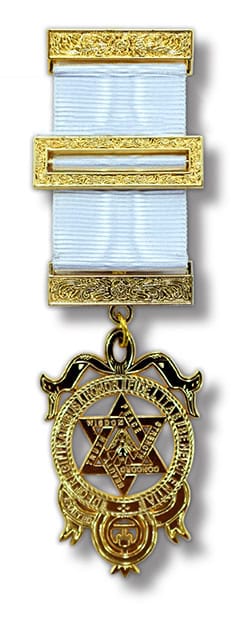
Jewel © UGLE
On the scroll are engraved the Latin words: ‘Nil nisi clavis deest (‘Nothing is wanting but the key‘) and between the two concentric circles: ‘Si talia jungere possis sit tibe scire satis’ (‘If thou canst understand what follows thou knowest enough‘). On the interlaced triangles there is again a double triad, but the triad on the second triangle is incomplete. The triangle with its apex pointing upwards is the spiritual triangle having on its base the inscription: ‘We have found’ in English, repeated in Greek (‘Exoupe 6pei‘) and Latin (‘ Invenimus ‘) on the other sides of the triangle. The triangle with its apex pointing downwards is the material triangle: its base is blank and on one of the other sides is ‘Cultor Dei’ (‘Worshipper of God‘) and on the other ‘Cives Mundi’ (‘Citizen of the World‘).
Following his Exaltation, a new Royal Arch Companion receives his Grand Chapter Certificate which he signs. His name is also engraved on the blank base of the material triangle, so that it reads: ‘… Worshipper of God – Citizen of the World’ The wearer is thus announcing that he believes in God and is a citizen of the world and also, more significantly, that he has found something. The search for the Word is one of the most important Masonic allegories.
In this context, ‘the Word’ may be seen, not as the Sacred and Mysterious Name of the Most High, but rather ‘the Word’ referred to in the opening verses of St. John’s Gospel, quoted above, namely: ‘In the beginning was the Word, and the Word was with God, and the Word was God’(John 1:1 KJV) meaning ‘the Will (or Law) of God’.
Arguably, the process of de-Christianisation of the Royal Arch ritual has obscured this meaning, geven that the Volume of the Sacred Law in our Lodges and Chapters is now opened at the first verses of Genesis, rather than those of St. John’s Gospel; and the words ‘In the beginning was the Word’ have disappeared from our Ritual.
A plain clue to the meaning of the Search was to be found in the old prayer for the Candidate at his Exaltation. Where today we say: ‘and may he ever remember that the object of our Institution is the welfare of our fellow creatures’, the original words were: ‘ever remembering that the object and intent of our Institution is obedience to Thy Sacred Laws’.
This is the key to that allegory which commenced with the second of the three knocks by which we first gained admission to a Masonic Lodge: ‘Seek and ye shall find’.
Thus, the Companion who has found the “Word” should certainly have his name engraved in the space on the Jewel. He should also be able to appreciate the meaning of the inscription: ‘If thou canst understand this thou knowest enough’ because the Will of God comprises all the tenets, precepts, and principles of Freemasonry; everything that it teaches. Happy is the Freemason who finds the Word and achieves understanding, for that Word incorporates the grand design of being happy and communicating happiness.
This explains, logically and historically why the Royal Arch Jewel has the form that many take for granted. It demonstrates conclusively the true meaning and profundity of the Royal Arch, an Order whose roots lie deep in a religious past. This depth is nowhere better expressed than in the conclusion of the Mystical Lecture, when it is pointed out that the Royal Arch ought to inspire its members with the most exalted idea of God, leading them to the exercise of,
‘the purest and most devout piety; a reverence for the incomprehensible, (or True and Living God Most High), the Eternal Ruler of the Universe, the elemental life and primordial source of all its principles, the very spring and fount of all its virtues‘.
Jack E Leggettas
Endnotes
[1] In the 19th century many Royal Arch Chapters met outside the normal hours for church services.
[2] Others claimed it was the initials of the maker of the Jewel: Thomas Harper.
*Note: All biblical passages are taken from the Authorized King James version unless otherwise specified.