

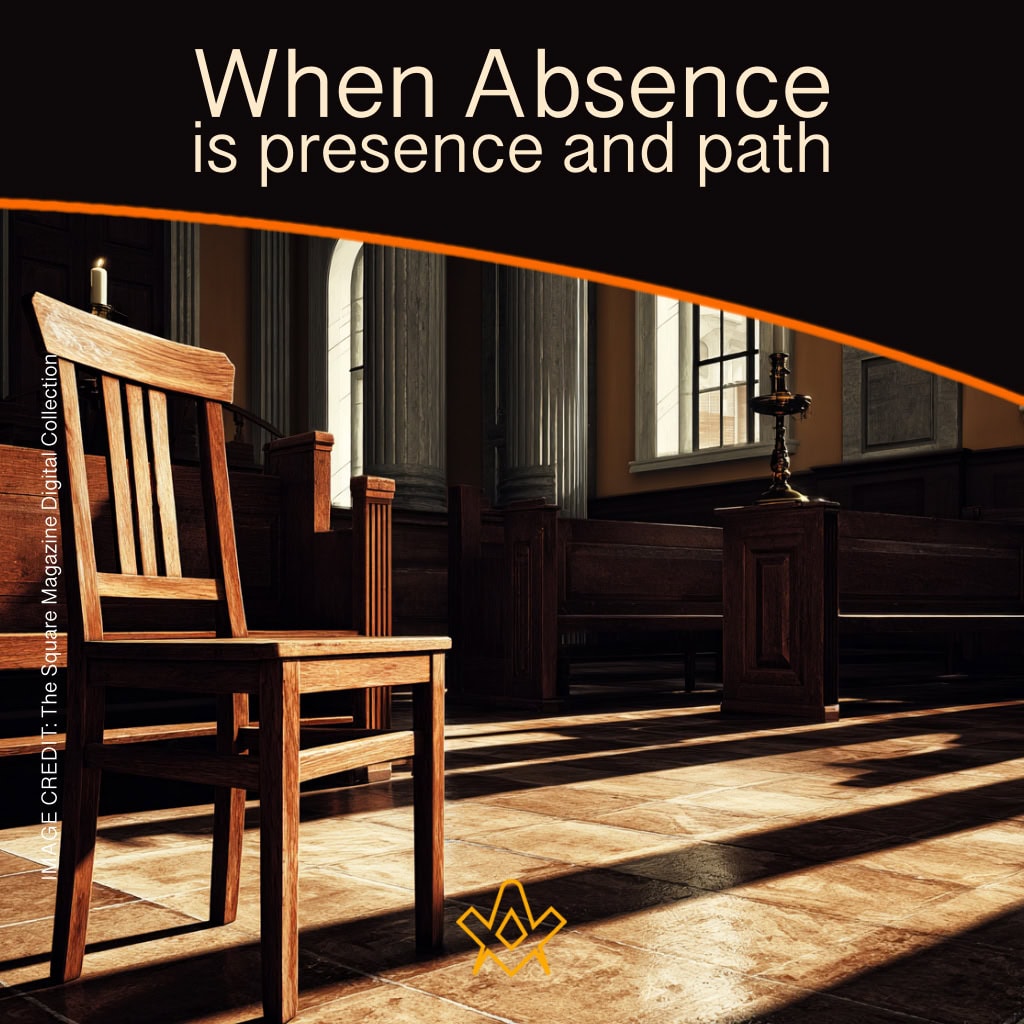
A reflective meditation on absence as presence, this article explores why a mature Freemason undertakes long journeys for brief Lodge meetings, revealing how duty, family, and inner fidelity converge in later life, where commitment is measured not in time spent, but in meaning carried home.
(Nicholas Broadway,
The Square Magazine Editor)
What motivation could a sixty-year-old man have to travel hundreds of kilometres and spend only two hours at a Masonic meeting? From the outside, the question seems legitimate, almost practical. From the inside, however, it reveals something else: the difficulty of measuring the value of what is not immediate, of what does not translate into comfort or rest.
At sixty, time is no longer offered with the distracted generosity of youth. Each trip weighs on the body, each absence is felt at home. The family remains, the table that is postponed, the shared silences that are not repeated.
A man of that age knows well what he leaves behind when he closes the door. And it is precisely because he knows this that the decision to leave is never frivolous.
He does not go out of escape, nor out of disinterest in his loved ones. He goes, often, with the silent consent of those who remain, sustained by an understanding built over years, shared routines, and mutual respect.
There is, in this gesture, a discreet form of trust: the family knows that this absence has meaning, even if it doesn’t need to be explained.
| Freemasonry, for those who have journeyed through it throughout a lifetime, ceases to be a space external to daily existence. It integrates with it. It becomes part of what shaped the man who returns home: more attentive, more serene, more aware of his limits and duties. The journey does not distance him from his family; paradoxically, it helps him return to it more whole. In the Lodge, these two hours are not just ritual time. They are a reunion with an ancient loyalty, with Brothers who also left something behind to be there. Each presence is, in this sense, an act of mutual respect: no one ignores the cost that this encounter had in the private life of each one. |
Traveling hundreds of kilometres is, therefore, a simple and profound gesture. It is not heroic, nor ostentatious. It is a commitment undertaken with lucidity, where duty does not oppose affection, but dialogues with it.
The man who leaves knows that family is his first temple and perhaps that is why he treats the second with equal reverence.
On his return, he brings with him the weariness of his body and a different quietness in his gaze. He returns home not as someone who was absent, but as someone who fulfilled his duty.
And in this fragile balance between leaving and returning, between being away and being present, a mature form of fidelity is built—to the Order, to the family, and to oneself.
Rui Calado, M. M. – Worshipful Master of the Lodge of Discoveries nº 9409 (UGLE)